A penetrating veracity of modern human life is the perpetual discord between intentions and actions, between ideals and reality, between potential and activities, between the lives we desire and the lives we actually live. Most people have habits they would like to let go of and plans they would like to act upon. Most of us are familiar with the feeling of harboring a tumultuous mind, jumping from thought to thought, filled with anxieties, distracted from our present activities and worrying about the future. On several occasions, we feel removed from our true selves, overpowered by our anger, sadness, worry, impulses, and overthinking; succinctly: we become “prisoners of our minds”.
Most of us would like to have better control over our brains- to be more focused, more mindful, more disciplined, more productive, and more peaceful. However, it is soon realized that making the positive, permanent changes we desire is a difficult process. At some point one may even begin to wonder whether one’s psychological struggles and flaws are really set in stone forever, or if the inability to change should be blamed on a lack of willpower, environment, circumstances, or other people. Are we truly doomed to be forever overrun by our brains, or is there scope for true change?
Perhaps the solution is not to try harder, but smarter—rather than mustering all our self-control and motivation to deal with our symptoms, perhaps we need to deal with the root causes of our problems. It is now fairly well-known that the happiest, most successful and most productive of people are not those with the highest amount of motivation, but those who develop and sustain good habits. A majority of our activities, both physical and mental, are shaped by our habits and in turn, by our environments, rather than by conscious, spontaneous decision-making or willpower. It is safe to say, in fact, that a good part of the course of our lives is dictated by the habits we form. Since making and breaking habits is a difficult process, it is worth examining the science involved behind these processes.
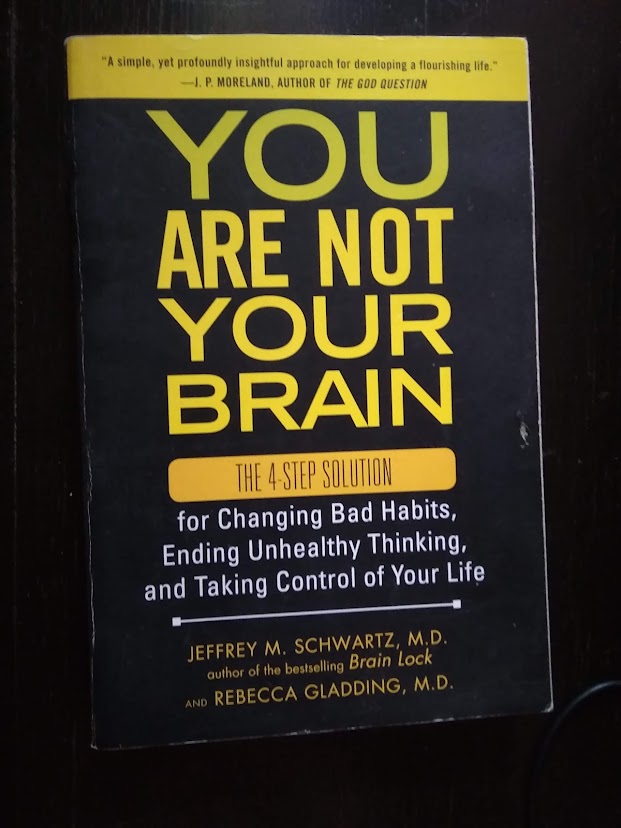
According to the celebrated neuroscientist Hebb, “the problem of understanding behaviour is to understand the total action of the nervous system, and vice versa.” “You are not your brain” is a book that offers to the layman a simplified and practical explanation of the human brain, particularly the functions involved in behaviour-formation. It subsequently offers science-backed solutions to “rewire” the brain to work for us, get rid of destructive habits and build new, healthy ones.
Distinguishing Mind from Brain
The authors of the book make a fundamental distinction between the brain and the mind, and their roles in our lives. Loosely speaking, the authors refer to “mind” as the aspect of our brains that knows what is best for us, what we need to be doing and avoiding, and what would make our lives better in the long term. More specifically, the term mind in the book refers to the conscious parts of the brain that harbor the perspective of one’s long-term well-being and interests. In the authors’ words, the mind “is involved in focusing attention, making long-term decisions, and embodies conscious awareness, which, in turn, processed the information presented to it by the brain.”
On the other hand, the term brain describes a more primal, instinct-oriented organ, which, in the author’s words, “receives inputs and generates the passive side of experience”. It functions in the “survival of the fittest” mode, processes information in rote, automatic ways, and produces survival-based reactions to the environment in a habitual, automatic way. An interplay between the roles of the brain and mind is crucial to a healthy, satisfying life. While the brain keeps us protected by generating immediate internal and external reactions to our environments, the mind is needed to make long-term decisions and overrule some of the brain’s instinct-based urges that cause us harm.
An asymmetry in the roles of the mind and brain can lead to a number of physical and mental health problems. For a neurotypical person, this asymmetry almost always leans towards an overreliance on the brain’s functions and an underplay of the mind’s role. A phrase that is currently in common use among wellness and lifestyle-related terms is “living life in autopilot mode”. Indeed, this is an apt phrase for a life dependent on the brain’s immediate urges and desires, where a person is likely to feel powerless and lacking direction. Such a person is constantly stuck with habits and thought patterns that cause unhappiness, while being unable to make changes in order to achieve the goals and lifestyle they truly want.
A rather extreme example is of a person who regularly procrastinates activities they want to get done (their work tasks, chores, and exercise) and instead caves into their temptations (such as video games, social media, alcohol, junk food), only to later feel regret and unhappiness, but yet is unable to get out of the vicious loop. A deeper look into popular culture shows that this example may be becoming less and less extreme statistically, and that a good deal of the youth lives close to it on the spectrum. This is not to say that we are to blame for our own conditions. To the contrary, our environment and circumstances reinforce this autopilot-based life and render change difficult.
Our brains have evolved for long in danger-ridden, scarce environments, where survival, sufficient food, and procreation were the major priorities. In modern day life, our primal tendencies manifest in different forms. Our brains often perceive danger and respond with anxiety, overanalysis, panic, and emotional suppression to the sometimes-harmless cues in our social environments. Simultaneously, they seek the overstimulation and excitement that result from the consumption of junk food, social media, video games, and so on. Activities and behaviours that would lead to long-term fulfillment do not “feel” rewarding immediately. This explains our difficulty to concentrate on our work or studies without interruptions, while we can easily while away hours scrolling social media.
Similarly, for several people, it takes serious motivation and drive to begin a workout routine, while it is so easy, almost automatic to reach for a bag of chips. Corporations, media, and marketing channels realize this weakness of the human brain, and exploit it to maximize the time and money we spend on their products and services. The food, entertainment, and information we have access to are designed to be overconsumed. Thus, our modern environment is crafted to promote our instinct-driven behaviours and make it difficult to escape their loop.
However, one need not lose all hope: while changing is difficult, it is not impossible. The authors of the book offer a method to rewire our brains to work for, rather than against us. They insist that biology is not destiny, and the key to rewiring our brains in ways helpful to us, is to learn to focus our attention through the mind. In order to explain their method and its working, the authors introduce several new concepts and terms, and explain them in a very simplistic, layperson format,
Key Definitions
A fundamental term that runs throughout the book is of deceptive brain messages, which are defined as the unhelpful, distracting thoughts, urges, and impulses, and desires which take one away from their true goals and intentions in life. The authors also make the important distinction between one’s true emotions and emotional sensations, which are uncomfortable, transient feelings caused by deceptive brain messages which cause us to act in impulsive, unhelpful ways. For example, a surge of anger or sadness and a resulting hysterical, impulsive reaction can be seen as rooted in emotional sensations, and are likely to be regretted later on. Similarly, the urge to calm one’s sensation of anger with unhealthy means like yelling, quarreling, or indulging in alcohol, can be seen as deceptive brain messages.
While caving into deceptive brain messages may provide temporary relief, the book explains how and why such behaviours set in as habits which later become hard to get rid of. The authors define habitual responses as “repeated or repetitive physical and mental actions response to emotional sensations”, and provide the much-relatable examples of repeated thinking and analyzing, rumination, mental compulsions, overthinking, cognitive distortions, automatic thoughts, negative thinking. Another key term is desire, which the authors define as the craving for a short-term, transient ourcome, event or feeling, which is not based on something stable and can “easily be derailed by lack of fast results, boredom, and competing priorities”. Similarly, cravings are “uncomfortable and painful sensations that go unseen, satisfying which provides momentary pleasure.
The authors insist, however, that while we cannot control the initial appearance of deceptive brain messages, we can use the power of the mind to stop ourselves from acting on them. Veto power is defined as the ability to refuse to act on a deceptive brain messages, uncomfortable sensation, or habitual responses. Similarly, “free won’t”, is the conscious free will not to initiate a voluntary act, and to choose better actions and responses to initial thoughts/sensations. Just as neuroplasticity fixes in bad behaviours when we engage in them, it can be used to form form adaptive, healthy circuits preferred when one focuses one’s attention on them. The conscious process by which a person may use the power of focused attention, commitment, hard work and dedication to direct their choices, actions, to rewire their brain to work for their true goals is termed by the authors as self-directed neuroplasticity.
The voice at the back of our heads which operates from the perspective of the bigger picture, sees the destructive reality of these deceptive brain messages, and tries to guide a person towards making rational decisions towards true health, happiness, productivity, and their long-term goals, is referred to as as a person’s Wise Advocate.
Components of the Brain
One may further understand the working of the brain by learning about its different components and their functions. Each of these is a complex amalgamation of different physical components, grouped together and named based on their functions. The book provides the following classification of the parts of the brain.
- Frontal Cortex/ Executive Center: Involved in strategy, organization, detecting errors, etc.
- Hypothalamus/Drive Center: Involved in primal drives such as hunger, thirst, and sex.
- Accumbens/Reward Center: Makes survival-based activities pleasurable so that we engage in them.
- Warning Center: When this center is activated, the other parts of the brain produce reactions and coping mechanisms to calm it down. Comprises the following parts.
- Amygdala :Responsible for assessing threats and indicating danger to the body through feelings of fear and physical sensations (rapid heartbeat, shortness of breath, sweating).
- Insula: Responsible for generating “gut-level responses” like dread, “pit in the stomach, gut-wrenching pain, etc.”
- Anterior cingulate: Involved in detecting errors, assessing risks and rewards, and generating the rapid sense that something is wrong.
- Basal Ganglia/Habit Center: Responsible for automatic thoughts (subcategory Caudate) and actions/movements (subcategory Putamen).
- Medial prefrontal cortex: Regulates self-thought, inner monologue, envisioning future, remembering the past, inferring other people’s states of mind.
- Orbitofrontal cortex/Self-Referencing Center: Regulates both automatic and voluntary actions such as error messages and obsessions.
- Assessment Center /Lateral prefrontal cortex: Involved in the voluntary modulating of responses from the Warning Center, overriding the actions the Habit Centre wants to initiate. Its key job is to help self-referencing centre to not take information too personally. It has the capacity to regulate and calm other areas based on external information.
The Origins of Deceptive Brain Messages
If deceptive brain messages are harmful and maladaptive, where do they come from and why are they so difficult to shake off? The authors of the book explain how many deceptive brain messages are learnt in our childhood. As children, we learn from our caregivers the expression of emotions, thoughts, actions, the treatment we deserve, how to react to situations, and carry forward what we learn for the rest of our lives. We also pick up unwarranted reactions such as catastrophization, overreaction, smothering, dismissal, negligence- from our caregivers and the other people we encounter as children, as reactions to deal with stressful situations. While this learning process continues throughout our lives, a large portion of it occurs in our childhoods, when our minds are still developing.
While the suppression of emotions may help with short-term coping, in the long run they cause immense (and unexplained) pain, lead to deceptive brain messages, poor habits, anxiety, depression, perfectionism, overthinking, overreactiveness, and so on. When the people around cope with stressful situations by ignoring, minimizing, and dismissing their true emotions and needs, the tender mind of a child subconsciously picks up these reactions, and they get silently wired into the child’s natural behaviour. When we grow up, the mind continues to conflate present life events to past hurtful ones, triggering the same painful sensations and learnt harmful behaviours.
Stressful triggers
But what exactly is a “stressful situation”? What kind of circumstances are triggering our “trauma responses” when we live in an environment where we are largely safe from immediate danger to our lives? While survival and procreation are key factors driving our primal instincts, social connectedness is an equally natural and necessary component of life for members of our species. We are shaped and affected by our desire to connect with people on an emotional level, feel safe, be heard and understood. The book explains the science of social pain, which is felt when a person feels neglected, ignored, dismissed, devalued, minimized, or, on the other extreme, overindulged and hyperfocussed. Social pain fires the Warning Center in the brain, and is registered and processed by the same parts as physical pain.
The book further talks about the theory of the “5 A’s” that we seek from other people: acceptance, affection, appreciation, allowing. This concept was introduced by David Richo, a well-known psychotherapist and author, who goes on to recommend seeking not more than 25 percent of these necessities from our relationships with others, and providing the rest for ourselves. However, a very small percentage of people actually have the emotional skills to make this providence for themselves. As a result, external circumstances, relationships with other people, other’s opinions of us, perceived or real social status, and so on, end up playing too big and destructive of a role in our lives.
The formation of bad habits
Habits are a key component of our behaviour. While good habits can pave the way to a productive, fulfilling life, bad habits can create a dangerous web of despair and frustration that is hard to get out of. It is thus crucial to be aware of when bad habits begin to form, and to do one’s best to cut them at the nip.
The book explains the neurological mechanism behind the cycle that enables the formation and entrenchment of bad habits. When a person is confronted with a psychologically stressful or traumatic situation, the Warning Center of the brain sends false alarms and generates uncomfortable physical and emotional sensations. Further, the Habit centre generates automatic thoughts and actions that seem to be out of one’s control. Other parts of the brain try to calm the Warning Center oh with unhealthy coping mechanisms (for instance, overthinking, catastrophizing, picking up a cigarette or alcohol, etc.).
The authors describe one of the most fundamental principles of neuroscience, Hebb’s law, which says that when groups of nerve cells (or brain regions) are activated together/in the same pattern at the same time repeatedly, they form a circuit and get “locked in” together. These brain areas then respond in the same way when a similar automatic way when a similar situation arises. In short, Neurons that fire together wire together. This law describes the mechanism in which our behavioural responses become unconscious, hardwired, automatic, and the mind stops getting involved in how we respond to the stressful situations that trigger them. When the brain circuits associated with the repetitive behaviour strengthen, one may even begin to crave them in the absence of the stressful triggers. Thus, giving into harmful temptations and impulsive reactions is called feeding the monster since it gives temporary relief but amplifies the intensity of the uncomfortable sensations. As a result, the next time a similar situation arises, the Drive Center is more likely to push the same unhealthy coping behaviour to calm the uncomfortable sensations, and the behaviour slowly becomes entrenched as an automatic habit due to the strong wiring together of the Self-referencing and Warning centres.
The crucial step to overcome bad habits consists of separating the conscious, voluntary mental processes from the ones we have no control over. The brain generates initial thoughts, sensations, urges, and desires that we cannot control. However, the authors insist that we can use our destiny is shaped not by these initial thoughts but by the subsequent actions and mental processes we produce in response to them. The process of behaviours being locked in requires a crucial catalyst from our conscious minds. The Quantum Zeno Effect is the phenomenon by which focused attention holds together and stabilizes the brain circuits by keeping them activated long enough for Hebb’s law to work, form new circuits, creates the standard hardwired responses to similar situations. Thus, the unconscious part of the brain is formed when we voluntarily and consciously provide it with fuel, in the form of our attention. Repeatedly focusing attention on thoughts, sensations, events, responses, and actions wires in the coping habits into our brains by letting the Quantum Zeno effect kick in.