Several years ago, I wrote a rather long article on subjective biases in science’s understanding of the inner lives of animals and the resulting impact on society’s perception and treatment of them. This was the result of a three month-long summer project, as part of which I studied the work of a select list of biologists, psychologists, ecologists, and philosophers to understand how supposedly scientific perceptions changed over time with the prevailing values, culture, and circumstances in society. While this phenomenon of the subjectivity of science has been studied intensively when it comes to biases against humans, the engagement of the social sciences on the matter is scant when it comes to non-human animals. I never managed to publish the paper in a journal, so I thought it a good idea to instead convert it into a series of blog posts. Of these, the present post serves as a primer. Converting from the academic language full of jargon to a light, readable blog post is rather effortful, so it may be a while before I can cover the whole content!
In recent decades, the notion that science is entirely objective and free from bias has been increasingly scrutinized. While science may claim to offer value-free truths, many critiques—particularly those focused on issues of gender, race, and sexuality—have exposed deep-rooted biases in scientific practices. However, one significant area of bias that often goes overlooked is the conceptualization and perception of nonhuman animals. Far from being impartial, the fields that study nonhuman animals have long been shaped by subjective beliefs, cultural norms, and material interests. Despite this, discussions of bias in science rarely address the ways in which nonhuman animals are systematically excluded from fair consideration.
Biases Toward Vulnerable Humans
Feminist theorists and other social scientists have effectively demonstrated that mainstream scientific knowledge has been shaped not only by the personal views of scientists but also by broader social and political agendas. This value-laden science has, at times, reinforced, rather than questioned, existing power dynamics, particularly with respect to gender, sexuality, and race.
For instance, while scientific and technological advances like the birth control pill have empowered women, science has also been complicit in marginalizing them. Biological sciences and psychology have often portrayed women’s cognitive and emotional traits as deviant or abnormal (Marecek, 1995), and natural bodily processes, such as menstruation and menopause, have been pathologized as illnesses (Ehrenreich, 1973). In research comparing male and female brains, studies frequently sought to establish male superiority in areas like spatial navigation, mathematical ability, and reasoning (Schiebinger, 1989), further entrenching gendered stereotypes.
Sexual violence, too, has been explained away using “scientific” rationalizations, with some sociobiological theories attributing rape to natural evolutionary impulses in men (Thornhill & Palmer, 2000). Similarly, the scientific establishment has historically supported heteronormativity and homophobia. Until 1974, homosexuality was classified as a mental illness by the American Psychiatric Association—a designation that was only overturned after protests from gay activists, not due to any scientific breakthrough).
These examples highlight a critical issue: science, far from being purely objective, is often shaped by the prejudices, value judgments, and cultural biases of the society that produces it.
The Exclusion of Nonhuman Animals from Social Discourse
In many fields, particularly in the social sciences, biases and oppressive ideas related to human identity—gender, race, and sexuality—have been rigorously critiqued. These discussions have led to important corrections in our understanding of human bodies and minds. However, nonhuman animals remain largely absent from these conversations, often relegated solely to the realm of the natural sciences.
This exclusion is not just a scholarly oversight; it reflects a broader societal tendency to distance nonhuman animals from the “social” domain. As a result, studies about their emotions, intelligence, and lived experiences have been left in the hands of natural sciences alone, where biases about human superiority have gone unquestioned. This means that the exploration of their inner lives—their emotions, intelligence, and experiences—has often been overlooked, misrepresented, or outright dismissed.
Just as scientists have assumed authority to define women’s bodies and experiences through a biased lens, they have also used a human-centric perspective to study and document the lives of nonhuman animals. Anthropocentrism—the belief that humans are superior and central to all value systems—has long dominated the biological sciences. This bias has led to the dismissal of animal intelligence, emotions, and consciousness as either irrelevant or inferior when measured against human standards. In doing so, science has perpetuated an exclusionary, human-centered worldview, often overlooking the complex inner lives of nonhuman animals.
The Emergence of Animal Studies
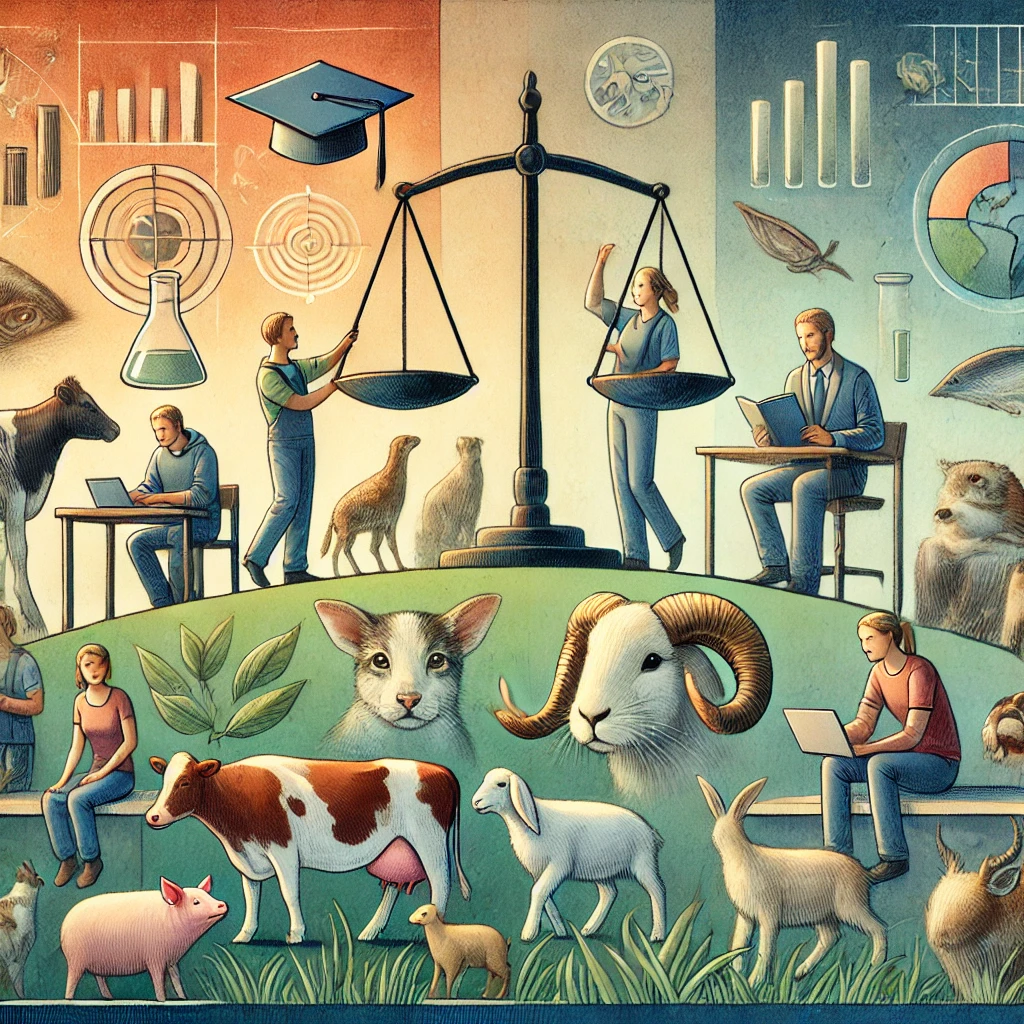
In recent years, the animal rights and liberation movements have gained significant traction, moving from the fringes into mainstream consciousness. Alongside this, the humanities and social sciences have begun to challenge the long-standing binary between humans and animals. This shift has given rise to the emerging field of Animal Studies, where the focus is no longer limited to humans alone but extends to nonhuman animals and their experiences. This growing interest in the ethical treatment of animals has led many to reconsider how science, particularly the biological sciences, has historically approached nonhuman animals.
Animal Studies
Animal Studies is an interdisciplinary field that explores the relationship between humans and nonhuman animals, examining their roles, representations, and treatment in society and across cultures. This field spans disciplines like literature, philosophy, anthropology, and biology, seeking to understand animals not just as objects or resources but as sentient beings with complex social lives and intrinsic value. The primary goal of Animal Studies is to move beyond the human-animal divide, challenging anthropocentric worldviews and recognizing the importance of animals’ experiences in shaping our ethical and cultural frameworks.
Critical Animal Studies (CAS)
Critical Animal Studies (CAS) takes a radical, activist-driven approach to the study of nonhuman animals, critiquing systems of exploitation, oppression, and speciesism. CAS is explicitly political, aligning itself with social justice movements like feminism, environmentalism, and anti-colonialism to expose the intersections between human and animal oppression. Unlike broader Animal Studies, CAS is focused on dismantling the structures that perpetuate violence against animals, promoting a vision of total liberation that includes both human and nonhuman animals.
Animal Welfare Studies
Critical Animal Studies (CAS) takes a radical, activist-driven approach to the study of nonhuman animals, critiquing systems of exploitation, oppression, and speciesism. CAS is explicitly political, aligning itself with social justice movements like feminism, environmentalism, and anti-colonialism to expose the intersections between human and animal oppression. Unlike broader Animal Studies, CAS is focused on dismantling the structures that perpetuate violence against animals, promoting a vision of total liberation that includes both human and nonhuman animals.
Animal Welfare Studies is a more practical field focused on improving the well-being and treatment of animals within existing human systems. It addresses the ethical and humane management of animals used for agriculture, research, entertainment, and other purposes. This field emphasizes reducing suffering and enhancing the physical and psychological health of animals, often working within legal and institutional frameworks. Unlike Critical Animal Studies, Animal Welfare Studies does not seek to abolish the use of animals by humans but instead aims to reform practices to ensure animals are treated more humanely.
Conclusion
In conclusion of this first part of the series, examining biases in science highlights the profound impact of societal norms and power structures on shaping knowledge, particularly regarding marginalized human groups and nonhuman animals. While significant progress has been made in addressing biases related to gender, race, and sexuality through social justice efforts, the study of nonhuman animals remains largely governed by an anthropocentric worldview that goes unquestioned. The emergence of Animal Studies and Critical Animal Studies challenges these norms, advocating for the recognition of animals as sentient beings with intrinsic value. By confronting and dismantling these deep-seated biases, science can advance toward a more ethical and comprehensive understanding of both human and nonhuman lives, fostering a more inclusive and compassionate approach to knowledge creation.