“Humans are omnivores”: one of the most thrown-around statements in discussions around human nutrition and eating habits. It is a favourite, especially, among opponents of the ethical argument against consuming animals. However, what does it really mean, and what are its true implications for how we eat and live?
Omnivore?
Scientifically, an “omnivore” is defined as an organism that consumes a variety of food sources, including both plant and animal matter. This diet contrasts with herbivores, which primarily eat plant material, and carnivores, which primarily consume meat. In most cases, the discussion seems to end here, with this statement taken to mean that humans being omnivores automatically means that we should be eating meat and other animal products, and that changing is not required. Convenient.
How much information does this definition actually give us? At first glance itself, it is so clearly overly vague: our ancestors consumed both plant and animal material, but how much of each? What percentage of their calories and nutrients came from each? How much of their time was spent on procuring each? The term “omnivore” is indeed overly broad and lacks specificity. However, almost always, thanks to social, cultural, and personal biases and wishful thinking, the meat component is given predominant importance. It is then worthwhile and crucial to examine the true evolutionary history of the human diet, for the scientific evidence tells the story not only of how our bodies work, but also of how our mental imagery, emotions, and biases propagate.
Everyone has an opinion on human diets
Human evolution has always been a matter of severe contention, both in the everyday and academic realms. Particularly in the former, it has consistently been pervaded by biases, emotions, and heated debates. Anthropology is the scientific study of the past and present of the human species, including their biology, cultures, societies, languages, and behaviour. Unlike many other specialized and niche physical sciences, the findings of anthropology tend to hold implicit meaning for the way we live our lives. Even though not inherently prescriptive in nature, implications are inevitably drawn from findings on the lives of our evolutionary ancestors about the way we should and should not live today. This is particularly true when it comes to eating habits.
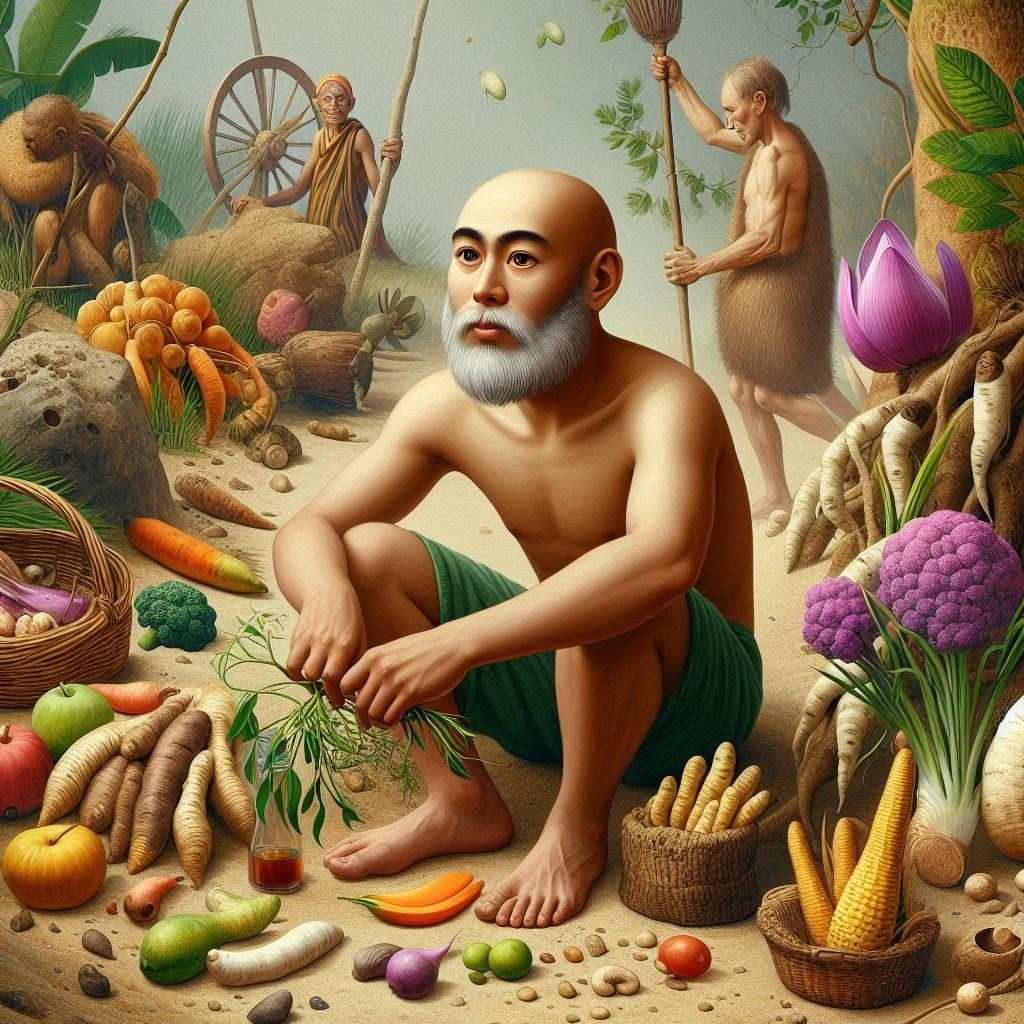
Food by itself is a contentious matter and an intensely emotional topic for most people, as it is so intrinsically tied to a person’s life: their routine, enjoyment, culture, family, festivals, religion, and emotions. When it comes to nutrition, few people are true experts, and yet, most have a formed opinion on the optimal diet and food habits. More often than not, this opinion is based on history: the food culture the person grew up with, the food their parents and grandparents ate, and, more often than not, going back much farther in time: the food they believe their ancestors ate. The last of these factors find basis in a variety of sources, ranging from anecdotes, and religious and historical texts to empirical anthropological studies. Increasingly, as popular science shapes more of our decisions and makes a place in our lives, one finds people citing science to back up their food choices.
Obsession with the “hunter” label
For years, the conventionally accepted theory was that meat-eating, combined with the use of fire for cooking meat, catapulted our evolution away from the greater primates and from Homo Erectus to Homo Sapiens. The image of early humans as rugged hunters braving the wilderness to bring down large game has captivated our imagination for decades. For some reason, it gives a good proportion of people a sense of pride and achievement to have their genes lived out this “glorious” history. The psychology of this feeling of pride, of the inherent, unquestioned sense of glory, this assumption of the superiority and machismo of a hunter and meat-eater over a gatherer herbivore, is a large enough topic for a separate investigation. The purpose of this article, however, is to question the accuracy of this predominant image of the human as a meat-eating hunter.
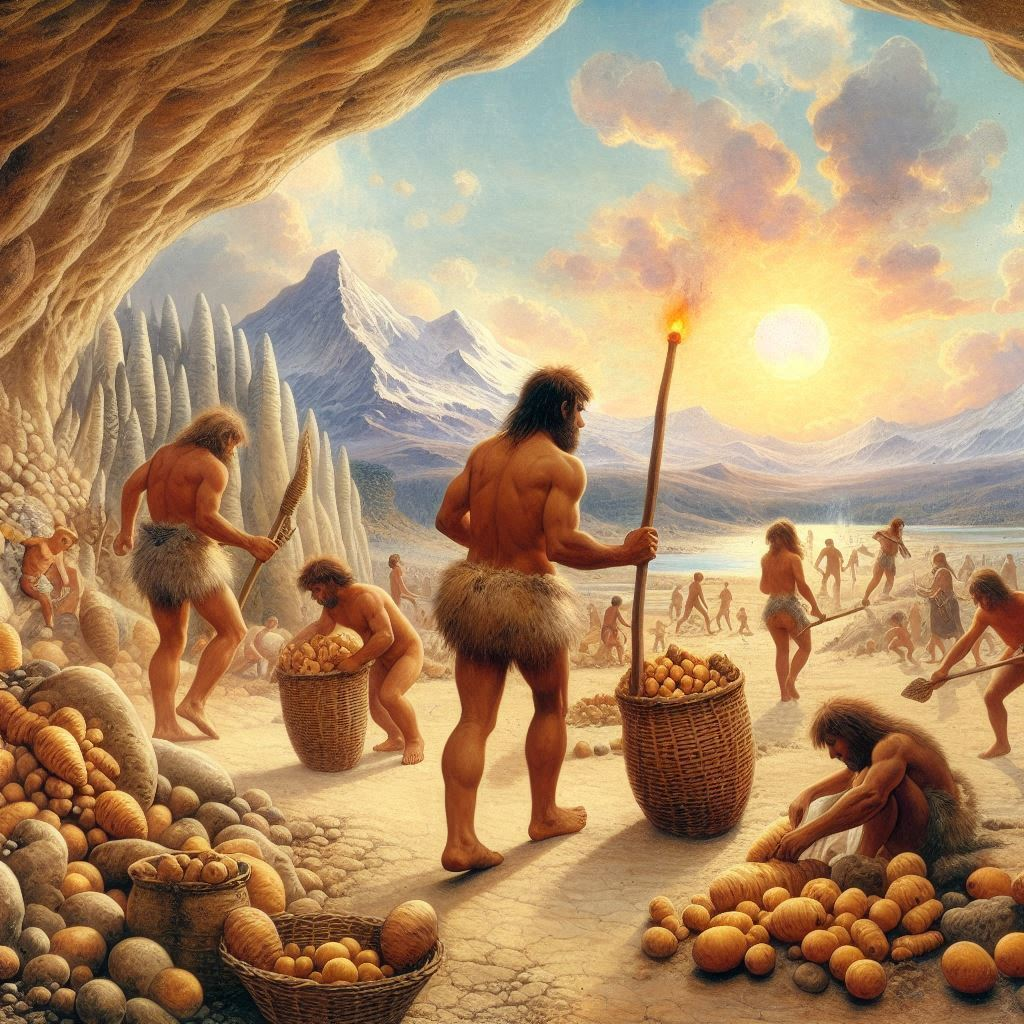
Indeed, recent scientific evidence suggests that our ancestors may have been more “starchivores” than hunters, relying heavily on gathered tubers, plants, and fruits for the majority of their calories. This challenges the traditional view of early humans as predominantly meat-eaters and raises questions about the true nature of our ancestral diet.
The truth about the ancestral diet
While humans are the only species of great apes that regularly hunted, and it is not up for debate that most human populations ate some meat, the component of the human diet constituted by meat has vastly and grossly been overestimated and exaggerated over the years. This theory is increasingly being challenged, and in fact, it is now fairly well-established that a majority of the diet of the ill-named “hunter-gatherer” ancestors consisted of plants.
While it is incorrect that these populations ate no meat at all, the question is not of whether but of the quantity. Meat is a scarce resource in nature, and despite the invention and use of tools, humans never evolved into apex hunters. Their primary occupation was gathering, and it is plausible and likely that a significant portion of their meat intake came through scavenging rather than hunting. Granted, hunting was done too, but the percentage of calories contributed through the hunting expeditions was on average very small compared to the calories from plants.
If not meat, then what? How did the brain grow?
The size of the human brain is one of the key factors setting us apart from the other great apes. Our brain contributes to merely 2-3 percent of our body weight but up to 25 percent of our energy requirements. In contrast, the brains of other apes constitute 8 percent of energy needs. While other apes spend about 5 hours a day chewing their food, humans spend just one to two hours eating.
The question then arises: if meat was not the golden factor carving out the evolution of Homo Sapiens, what exactly did set us apart, allowing our brains to grow in size, for subsequent innovation, and the development of civilizations? Clearly, all the other great primates are primarily herbivorous, but have smaller brains, and spend a good majority of their days chewing on low-calorie-dense leaves and fruits to fulfill their caloric needs. There has to have been something that freed up the time and energy to allow for humans to undertake activities like building up civilizations. Indeed, there was a key component in our diets different from meat which differed from the diets of other apes, and was harnessed only through the use of fire.
The use of fire makes a difference, but its true potential is realized when combined with starchy foods like tubers and grains, whose calorie density is several folds higher than that of fruits (which are also region and season-specific) and non-starchy vegetables. Starches were available to early humans in the form of tubers, seeds, fruits, nuts, and wild grains. These are hard to digest raw, but While the question of whether starch-rich foods or meat served as the most critical high-energy source for our ancestors is a heated debate among academic circles, it is relatively less known among common people, who see herbivorous grazing-like feeding behaviour as the only antithesis of the meat hypothesis.
Scientific Evidence
The recent scientific research on this topic has all consistently supported the starchivore hypothesis. Some selected examples are described below.
- Dental Analysis and Microfossils:
- Dental Plaque Studies: Analysis of dental plaque from Neanderthals and early Homo sapiens reveals remnants of plant starches, indicating a significant consumption of tubers and other plant-based foods. Microfossils of starch grains from roots and tubers have been found embedded in the dental calculus of ancient human remains .
- Tooth Wear Patterns: The wear patterns on fossilized teeth of early humans show evidence consistent with the grinding of tough, fibrous plant material rather than just meat. This suggests a diet rich in plant matter .
- Stable Isotope Analysis:
- Carbon Isotope Ratios: Studies of stable carbon isotopes in ancient human bones reveal a diet that was heavily reliant on C3 plants (such as tubers, fruits, and nuts). This isotope analysis indicates that plants formed a substantial part of the diet, with less reliance on meat than previously thought .
- Archaeobotanical Evidence:
- Plant Remains: Archaeological sites have yielded an abundance of plant remains, including seeds, nuts, and tubers, suggesting that gathering these resources was a major part of early human activity. For instance, evidence from the Middle Stone Age sites in Africa shows that humans were using fire to process plant foods, which made tubers and other starchy plants more digestible and calorie-rich .
- Tool Use and Wear:
- Grinding Stones: The discovery of grinding stones and other plant-processing tools at archaeological sites further supports the hypothesis that early humans were processing and consuming significant amounts of plant foods. These tools show wear patterns indicative of grinding seeds and tubers .
- Ethnographic Comparisons:
- Modern Hunter-Gatherer Societies: Observations of modern hunter-gatherer societies, such as the Hadza of Tanzania, reveal that a large portion of their diet comes from gathered plant foods, including tubers, berries, and fruits. While they do hunt, the majority of their caloric intake is plant-based, suggesting that this pattern may have been similar for early humans.
In particular, while casually glancing around the internet, I came across two important publications that have come out recently. The first, titled “No sustained increase in zooarchaeological evidence for carnivory after the appearance of Homo erectus” (https://www.pnas.org/content/119/5/e2115540119), “finds no sustained increase in the relative amount of evidence for carnivory after the appearance of H. erectus” thereby disputing the primacy of meat-eating in our evolutionary history,. The second, titled Reconstructing Neanderthal diet: The case for carbohydrates (https://www.sciencedirect.com/science/article/pii/S0047248421001573) “examines potential patterns in the diets of the Neanderthals, finding that populations of humans are u_nlikely to have thrived and reproduced without_ plant-based carbohydrate-rich foods”. In another paper (https://www.pnas.org/content/pnas/113/37/10298.full.pdf), trapped starch in dental extractions of early human fossils showed that “Late Mesolithic foragers of the central Balkans consumed domesticated specimens of wheat and barley at least from ∼6600 cal. BC, almost half a millennium earlier than previously thought.”
Indeed, modern-day humans provide ample evidence for this theory, as well, despite the unfortunate popularization of low-carbohydrate diets. Carbohydrates are the primary fuel source for our bodies, and the brain is likely unable to function in a healthy way for long periods with “ketones” as the primary fuel source. In the following article, the case for the popular low-carbohydrate “paleolithic diet” is refuted, by building a case for the importance of carbohydrates for the evolution of modern big-brained humans: (https://fli.institute/2015/08/19/paleo-diet-big-brains-needed-carbs-the-importance-of-dietary-carbohydrate-in-human-evolution/). The leader of the study states “the evidence suggests that Palaeolithic humans would not have evolved on today’s ‘Paleo’ diet.” In the study (https://www.sydney.edu.au/news-opinion/news/2015/08/10/starchy-carbs–not-a-paleo-diet–advanced-the-human-race.html), the crucial role of carbohydrates in the development of the large brains of modern humans is emphasized_._
I found similar information in the well-researched, bestselling novel “Sapiens” by Yuval Noah Harari, who demonstrates an excellent, well-rounded understanding not only of our history, but also of the developments of the present day, establishing himself as perhaps one of the most knowledgeable and insightful figures on the state of the human condition.
Rationale
So, a majority of scientific evidence points towards early humans being near the herbivore-starchivore side of the broad omnivore spectrum. But, is this truly surprising? In fact, when one thinks about it logically, it makes a lot of intuitive sense. Two supporting arguments are as follows.
- Hunting Risks and Returns: Hunting large game was risky and often unsuccessful, making it an unreliable food source that could also lead to the hunters getting lost, injured or eaten by other species. Conversely, gathering plant foods was more predictable and less risky.
- Spoiled and Rotting Flesh: The consumption of spoiled and rotting flesh was likely as deadly to our ancestors as it is to present-day humans. Thus, all hunted meat had to be consumed in a relatively short period of time, and could not serve as a long-term source of calories.
- Availability and distribution: Early humans lived in close-knit bands and tribes which likely comprised hundreds of people. When a band or tribe did manage to hunt down and animal for food, they had to distribute the flesh among tens, even hundreds of other people. The quantity that remained for consumption by a single person was therefore a very small part of their overall diet.
Conclusion
In this first part of the article, I argued against the popular projection of early humans as primarily hunters and the downplay of the more important part of their activities, gathering. The scientific evidence points to a diet heavily reliant on plant-based foods, with a heavy emphasis on starches (cooked with fire) for calories, making the term “starchivore” a more accurate descriptor. Understanding this aspect of early human life not only enriches our knowledge of human evolution but also sheds light on the nutritional strategies that have shaped our species, and gives us important insights on where we are going wrong in structuring our diets today. In the next part, I will describe and discuss the scientific findings in more rigorous detail, and talk more about the implications for the human diet in 2024.