The world has suddenly plunged into an unexpected and dire situation in the past few months, needless to say, by the COVID-19 pandemic. Naturally, the current state of affairs brings a tremendous amount of anxiety to people from every walk of life. While medical professionals, sanitation workers, and other officials battle things out at the forefront, a majority of us sit in our homes, possibly doing our jobs remotely and nervously waiting for things to de-escalate to normalcy. While several of us have the privilege of using the time saved on travel and socialization on creative pursuits, some others lack the privileges of privacy and financial and social security to be able to think of things like poetry, art, and fiction. Undoubtedly, a person who must worry about their survival and safety is most likely not writing ballads, no matter how much extra time they have at their disposal.
For those of us who do have this privilege, it would be interesting to use the current situation as a starting point to contemplate the general nature of intellectual freedom. It is now clearer than ever that creativity and intellectual productivity are not a function purely of talent, education and free time. They are both entangled in a complex manner with one’s economic and social situatedness. One crucial aspect of both our social and economic positions is constituted by one’s gender. What role does gender play in shaping one’s intellectual freedom?
A woman must have money and a room of her own if she is to write fiction.
The above quotation is from a famous essay by one of my favourite authors. Virginia Woolf’s A Room of One’s Own is a well-renowned classic feminist text which presents the struggles of women who are, or aspire to be, writers. In the process, it stumbles upon the perplexing question of why, largely, women are so much poorer than men and how this affects their chances at being successful writers.
Intellectual freedom depends upon material things. Poetry depends upon intellectual freedom. And women have always been poor, not for two hundred years merely, but from the beginning of time.
Though this essay’s focus is on the profession and art of writing, I would ascertain that the discourse applies to every professional and hobbyist field that requires creative contemplation. Moreover, while several facets of the theory are unique to the condition of women, the gist of the arguments could be used to explain the under-representation of any socially disadvantaged group in creative domains.
Women in Creative Fields
In A Room of One’s Own, Woolf picks up an important strand of the question that is the favourite of many of the world’s biggest patriarchs: why have women not been nearly as successful as men in any professional or creative field? Why have most of the famous scientists, poets, screenplays, artists, philosophers and politicians been men? Why do women own less wealth and property than men? And finally, how are the former two questions related to the third?
Why did men drink wine and women water? What effect has poverty on fiction? What conditions are necessary for the creation of works of art?
Woolf asks a literary version of all these questions condensed into one: Why has the world never seen a female Shakespeare? Now, there exist umpteen illustrious textbooks and university courses explaining the multi-faceted systematic discrimination that prevented (and still prevent) women from becoming great writers, poets and screenplays. Many other works also provide sufficient and thorough examples of the genius of women in every conceivable human endeavour.
Fortunately, a layperson need not read many abstractions and theory to understand the answer to this question. In fact, the answer is explained with a short hypothetical story within the essay, in which the author draws up what would likely have been the life of Shakespeare’s sister, if she existed. This story explains simply why this woman would have failed, by sole virtue of familial and social barriers put up against her sex, to achieve what her brother could. It demonstrates that creative work demands a luxury beyond a financially sound birth; it demands the luxury of privacy, leisure, and a free mind, all of which are exiguous among womenfolk. It also demands that available wealth, along with the knowledge and power to use it, are actually accessible to the artist (here, specifically, the woman). A woman who takes birth in a prosperous family but has no say in how her share of the riches is used is in reality no wealthier than a pauper.
_At the thought of all those women working year after year and finding it hard to get two thousand pounds together, and as much as they could do to get thirty thousand pounds, we burst in scorn at the reprehensible poverty of our own sex. What had our mothers been doing that they had no wealth to leave us?
If only Mrs. Seton and her mother and her mother before her had learnt the great art of making money and had left their money, like their fathers and their grandfathers before them, to found fellowships and lectureships and prizes and scholarships appropriated to the use of their own sex.
Now if she had gone into business, had become a manufacturer of artificial silk or a magnate on the stock exchange, if she had left two or three thousand pounds to Fernham, we could have been sitting at our ease tonight and the subject of our talk might have been archaeology, physics, the nature of the atom, mathematics, astronomy, relativity, geography.
We might have been exploring or writing; mooning about the vulnerable places of the earth; sitting contemplative on the steps of the Pantheon; or going at ten to an office and coming home comfortably at half-past four to write a little poetry._
Indeed, the life-like thoughts above enable one to comprehend the extent to which the lack of financial freedom has impaired the creative freedom of women.
Writings on women
Apart from texts written by women, A Room of One’s Own also talks a lot about the things said and written about women, their minds, lives, capabilities, and duties, throughout history. It is unimaginable how many men’s opinions have been recorded about what a woman is like, how she thinks, what she wants, and how she ought to live. This is a rather well-known fact, yet it is most striking personally when Virginia Woolf formulates the question in this manner:
Have you any notion how many books are written about women in the course of one year? Have you any notion how many are written by men? Are you aware that you are, perhaps, the most discussed animal in the universe?
For centuries, we have allowed ourselves to be represented by the pens and mouths of another. This is perhaps the biggest reason why we have consistently been portrayed as inferior, lacking, and even mysterious, across cultures and societies. The nature of women isn’t just a casual topic of small talk in a card room during tea time; it is the subject of a systematic and global discourse that is consistently found to be entirely laden with biases, wishful thinking, and blatant lies.
Napoleon thought them incapable. Dr. Johnson thought the opposite. Have they souls or have they not souls? Some savages say that they have none. Others, on the contrary, maintain that women are half divine and worship them on that account. Some sages hold that they are shallower in the brain, others that they are deeper in the consciousness. Goethe honoured them; Mussolini despised them. Wherever one looked men thought about women and thought differently.
In fact, the issue of opinions on women also finds a generous amount of discussion in some of the powerfully yet realistically worded passages of another work by Woolf, a fiction titled “The Voyage Out”. For instance, perhaps slightly ironically, Mr. Hirst, a cynical male character of the story articulates this with impressive precision and emotion.
Of course we’re always writing about women – abusing them, or jeering at them, or worshipping them, but it’s never from women themselves. I believe we still don’t know in the least how they live, or what they feel, or what they do precisely. It’s the man’s view that’s represented, you see. Think of a railway train: 15 carriages for men who want to smoke. Doesn’t it make your blood boil? If I were a woman I’d blow someone’s brains out.
A Room of One’s Own, as well as many other feminist works, demonstrate beyond doubt that the representation of women by others is as significant a matter issue as women’s representation of themselves. But not only does Woolf set her work apart from traditional theory by presenting the issue in a simple, concise and witty form suitable for anyone to absorb, she also points out that the damage to women by their misrepresentation extends beyond merely biases and untruths. Not only have women been objectified and then denigrated, but the whole process of this objectification has been turned into a source of entertainment, a leisurely or, in some cases, a professional activity, and an art of sorts, which is rewarded with attention, applause, fame, and even money. In fact, the more the absurdity, ridicule and malevolence a viewpoint harbors the more proponents it is likely to garner. A few thought-provoking stanzas from A Room of One’s Own expound this phenomenon powerfully.
Women do not write books about men. Why are women, judging from this catalogue, so much more interesting to men than men are to women?
Sex and its nature might well attract doctors and biologists; but what was surprising and difficult of explanation was the fact that sex – woman, that is to say – also attracts agreeable essayists, light-fingered novelists, young men who have taken the M.A. degree; men who have taken no degree; men who have no apparent qualification save that they are not women.
I began idly reading the headlines. The most transient visitor to this planet, I thought, who picked up this paper could not fail to be aware, even from this scattered testimony, that England is under the rule of patriarchy. Nobody in their senses could fail to detect the dominance of the professor. His was the power and the money and the influence. He was the proprietor of the paper and its editor and sub-editor. He was the foreign secretary and the judge. …With the exception of the fog he seemed to control everything. Yet he was angry. I knew he was angry by this token. When I read what he wrote about women, I thought not of what he was saying but of himself. When an arguer argues dispassionately he thinks only of the argument and the reader cannot help thinking of the argument too. If he had written dispassionately about women, had used indisputable proofs to establish his argument and had shown no trace of wishing that the result should be one thing rather than another, one would have accepted the fact, as one accepts the fact that that a pea is green or a canary is yellow. So be it, I should have said. But I had been angry because he was angry.
The last paragraph quoted above nails the reason why a male-dominated theory of women should produce in us anger beyond our dislike for lies. The biases and untruths long believed about women are more than just falsities, they are wishful lies. The “professor” does not merely believe that women are inferior, he wants with all his heart for this belief to be true, and from here grows his passion to defend it. Statements on the inferiority of women do not spring solely from ignorance or even from pure hatred.
Personally, I never understood where this general raging need to tear other people down arose from, or why anyone bothered with hating others so passionately when life is already so short and its pleasures so numerous. It was all the more difficult to understand this phenomenon when it involved entire genders and races. I believe I have found my answer in this essay by Woolf. Hatred and denigration of others are rooted in one’s egocentrism, in the fact that a human only views themselves as worthy when they can justify their superiority to another:
Yet it seemed absurd, turning over the evening paper, that a man with all his power should be angry or is angry. Or is anger, I wondered, somehow the familiar, the attendant sprite on power?”…The professors, or patriarchs, as it might be more accurate to call them, might be angry for that reason partly, but partly for one that lies a little less obviously on the surface. Possibly they were not “angry” at all; often, indeed, they were admiring, devoted, exemplary in the relations of private life. Possibly when the professor insisted upon the inferiority of women, he was concerned not with their inferiority but with his own superiority. That was what he was protecting rather hot-headedly and worth too much emphasis, because it was a jewel to him of the rarest price.
Life for both sexes-and I looked at them, shouldering their way along the pavement-is arduous, difficult, a perpetual struggle. It calls for gigantic courage and strength. More than anything, perhaps, creatures of illusion, as we are, it calls for confidence in oneself. Without self-confidence we are as babes in the cradle. And how can we generate this imponderable quality, which is yet so invaluable, most quickly? By thinking that other people are inferior to oneself. By feeling that one has some innate superiority-it may be wealth, or rank, or a straight nose, or the portrait of a grandfather by Romney, for there is no end to the pathetic devices of the human imagination- over other people. Hence the enormous importance to a patriarch who has to conquer, who has to rule, of feeling that great numbers of people, half the human race indeed, are by nature inferior to himself.
_ Women have served all these centuries as looking-glasses possessing the magic and delicious power of reflecting the figure of man at twice its natural size..whatever may be their use in civilised societies, mirrors are essential to all violent and heroic action. That is why Napoleon and Mussolini both i_nsist so emphatically upon the inferiority of women, for if they were not inferior, they would cease to enlarge._
The Human Angle to Oppressive Systems
To me, the above stanzas answer quite satisfactorily not only the question of why men have portrayed women as inferior, but also why different groups of people across the world are so insistent on the inferiority of the “other”: be it a different gender, race, culture, nationality, or religion. It explains our need to find some flaw or shortfall in our neighbor, no matter how much we may love them. It shows why some people need to hate someone else in order to love themselves.
It also explains why humans have forever been obsessed with what sets them apart from (most often interpreted as what makes them better than) non-human animals. From religion to science, most human discourse has perpetually tried to establish the superiority of its species with the same passion, egocentrism and ignorance harbored by men trying to defame women. I can now see, from the lucid and ingenuously simple explanation offered by Woolf, that the underlying reason is also identical. For surely at some point the satisfaction of superiority over a relative or neighbour or another gender saturates and loses its charm. It is perhaps then that humans are driven to prove their distinctive superiority over every other living being on this planet, and even to use it as a justification for exploiting them. Indeed, this extension is not as far-off and tucked away in theory and imagination as it may seem at first. In The Voyage Out, Mr. Hirst is seen saying to Rachel, referring to the influence that, men seem to hold over women.
I believe we must have the sort of power over you that we’re said to have over horses. They see us three times as big as we are or they’d never obey us.
It is unknown whether Woolf was conscious of the deeper connection that underlies this comparison, but the very fact a reader can pass it by without a second thought shows that humans subconsciously acknowledge that their oppression of other humans is no different from their exploitative subjugation of non-humans.
Coming back to A Room of One’s Own, I believe that the few above quoted paragraphs demonstrate another unique and delightful quality of the essay, which does a lot to set it further apart from other feminist texts. The author is certainly charged with anger at perpetual injustice against her gender, and lays forward her keen observations on this injustice, successfully tearing apart the fundamental insecurities and egocentrism of patriarchs. And yet, remarkably, in the very same lines, she empathizes with them. She realizes a system of discrimination as purported by the fundamental (but changeable) flaws of humans and their existence. While feminism is usually studied as a social and political theory, Virginia Woolf subtly blends in psychology to explain the human angle to an oppressive structure.
It would be hard for most of us to claim with honesty that as individuals we have never wished to see anyone else in a dimmer light so that we seem brighter to ourselves and others. We always want to seem less intimidated, less clueless, and less anxious than we actually are. Here I am reminded of the following eloquent summarization of the human condition, which happens to be one of my favourite passages from The Voyage Out.
That was the strange thing, that one did not know where one was going, or what one wanted, and followed blindly, suffering so much in secret, always unprepared and amazed and knowing nothing; but one thing led to another and by degrees something had formed itself out of nothing, and so one reached at last this calm, this quiet, this certainty, and it was this process that people called living.
With this uncertain and unprepared state of mind, self-confidence is naturally something humans are constantly gripping for. While some of us are able to find meaningful pursuits to rely on for our sense of achievement and dignity, yet others focus their energies almost entirely on making others smaller, and possibly from here spring the founders of systems designed for the purpose of belittling and subjugation.
Conclusion
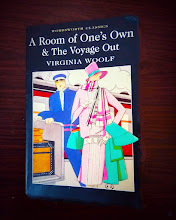
It is only a few books that can move one to write so much describing them and to beseech others to experience their magic personally. A Room of One’s Own is indeed one of them. Fortunately, I happened to buy a book that combined this essay with a related and equally brilliant fiction, The Voyage Out. Several dialogues, themes and observations from the latter fit in perfectly with the discourse of the former. Though there were many more remarkable stanzas and quotations from The Voyage Out that I would love to bring to a potential reader, I have refrained from including them in this piece because they are unrelated.
As I have tried to illustrate, A Room of One’s Own centres on the themes of women and fiction, but is also far more. It talks just as much about writers, poetry, creativity, and intellectual freedom. A thoughtful reader may also pick up some philosophy while turning its pages. Indeed, the true beauty of this essay is in its versatility. The condition of women and the subject of intellectual freedom are so closely intertwined that almost every observation on one of them yields an interesting insight on the other, and it is precisely this fact that the essay embellishes.
One of the best things about this essay is its ability to take its readers’ thoughts and emotions on calm and soothing rollercoaster rides. The author asks effortless yet intricate questions that can make even a feminist scholar reflect for hours. She then offers simple, tangible answers that anyone can relate to, yet without reducing them to a single dimension. She offers no doctrines or formal theory, only conversation, dialogue, and stories. Without using the word feminism, she explains its essence to the reader more effectively than a good proportion of sociology textbooks.
But we must be careful to not overlook one of the most crucial messages of the essay. The text is not merely an observer’s formulation of facts, nor is it merely an insight into the condition of women, nor merely a comment on intellectual freedom. The essay as a whole is a call to action. It entreats women everywhere to struggle against adversity and oppression and seek prowess, excellence and honour. It beseeches us to invest our time and money in worthy pursuits and leave behind a glorious legacy of knowledge and art. It reminds us to never forget our responsibility to make the best use of our mental, physical, and material resources. This message implicitly lingers as an emotion in the entire text, and is seen explicitly in the moving ending of the essay, a line from which I quote below.
I should implore you to remember your responsibilities, to be higher, more spiritual; I should remind you how much depends upon you, and what influence you can exert upon the future.
The woman of today packing her bag and leaving home to attend university or office or to cast a vote without a second thought must not erase from her memory the ridicule and violence faced by her female ancestors from a century ago for demanding these basic rights. Undeniably, humans in general tend to take history for granted: to treat it as a piece of fiction meant to fascinate or pride or horrify us. We enjoy stories of battles fought centuries ago, and spend several evenings discussing the peculiar lives of our far-off ancestors. However, we can never truly ‘know’ what it means to live through the adverse times of the past. Similarly, as economically well-off women living in modern societies and democratic countries, it is naturally hard to imagine a world where patriarchy was the official familial, social, economic and political norm.
There is no denying that women are, even today, far from achieving true and complete equality with men. Their abilities and efforts are still questioned, undermined and treated with lower priority. Women still struggle to be paid at par with men and to have basic rights like protection from sexual harassment, domestic violence, rape, discrimination, and casual sexism. There is still a long way to go before gender equality is reached, but we are far ahead on this rugged path than our ancestors were, thanks to their very battles, and we must not forget this.
A woman today who is adamant that she is not a feminist, or “chooses” to give up every form of productive and creative pursuit to fit into patriarchal norms, uses sexist standards to criticize and even insult other women, or embraces and even celebrates patriarchal symbols, does a greater disservice to women from the past, present, and future, than the staunchest of patriarchal men.
Society is still in the clutches of patriarchy, but the clutches yesterday were a hundred times more powerful and piercing. It is our responsibility to continue to destroy these clutches, of course because that is the only way for a righteous future for human societies, but equally as a tribute to the sacrifices by our sisters from the past. We owe to the world the great female poets and writers it has hardly ever seen; we owe it a rewriting of our realities, and a realization of our talents. I conclude this article with the same line used by Virginia Woolf to conclude A Room of One’s Own, for I could not find a better formulation of this message.
But I maintain that she [the poet] would come if we worked for her, and that so to work, even in poverty and obscurity, is worthwhile.